Search This Blog

Wednesday, 14 January 2015


Chui is a Village in Mon Tehsil in Mon District of Nagaland State, India. It is located 2 KM towards East from District head quarters Mon. 397 KM from State capital Shillong. Chui is situated in Mon sadar tehsil and located in Mon district of Nagaland. It is one of 18 villages in mon sadar Block along with villages like Leangha and Totokchingnyu.
An imposing statue of the Angh chief, Wangkhao Angh, with elaborate accessories stands on the entrance of the Angh’s house in the biggest house of the Chui Village or Basti. Chui village is considered another key destination for tourists wanting to know about the warrior tribes- Konyaks. The head-hunting tribe that full-fledgedly practiced their customs may no longer be seen in entirety, but there are several remains of the glorious past in this village.

Tuesday, 13 January 2015

Nagas The Head Hunters

Head-Hunting
Inter-village wars, culminating in the taking of the enemy's heads, were part of every day life among the Nagas. Head hunting was a practice which organised out of a belief that the soul-matter, on which all life depended, was stored in the head of human beings. So whenever a person was beheaded and his head taken to another village, the soul matter inside the severed head was also transferred to that village. The recipient village, it was believed would gain in prosperity, its population would increase, cattle would multiply and the crops would be luxuriant.
It would seem that the entire philosophy of Naga life revolved around the practice of head hunting. It was not only the cause and effect of war, it was also the inscription for the Naga works of art. Most of the traditional Naga carvings  and patterns on textile have head-hunting as their motif. The village drum could not be beaten, unless a head had been taken and placed on it. The warrior who hunted a head was entitled to wear special kinds of dress and ornaments. A person who did not have a single head to his credit had difficulty in getting a bride and became an object of ridicule with the girls.
Women and children were not spared in head-hunting. In fact, a woman's head was considered a more prized trophy, for a variety of reasons. As women were always given the maximum protection by the village folk, taking a women's head meant penetrating deep into the adversary's ranks with all its risks. Another reason was probably the desire to reduce the enemy population by killing their women folk and yet another reason could be the desire for women's hair which was used for ornamental purposes. Heads of children who had cut their teeth were also taken.
Because of head hunting, villagers took utmost care in the morning, before the women and children moved out, the surrounding areas was combed by a group of village young men to make sure that no enemies were waiting in ambush. They went to the field in a group so as to meet any sudden threat. While others worked, some people were kept on guard duty. The village gate was securely closed before the men retired for the evening.
The normal Naga method of fighting is the guerilla way. The enemy is to be surprised and caught, unawares, maximum possible damage is to be inflicted on him and the attacker should beat a hasty retreat before any succour comes to the victims. There are also some rare instances of one village having challenged another to a fight at a particular place. Fights took place on a number of issues such as land disputes and for not paying the agreed marriage-price or for sheltering an offender from another village or a customary welcome had not extended by one of the villages. A woman whose husband had gone on a fight was expected to remain chaste, it was believed that otherwise he could certainly be killed by the enemy. Among the Lothas, women were also forbidden to weave, and it  was believed that any break of this rule would cause the husband's feet to get entangled in creepers where upon he would be caught and killed by the enemy. 
Different tribes had different customs to dispose of the heads taken. The Angamis kept the head on a certain stone in the village, and it was welcomed with food and drink. After the ceremonies were over, the head was buried outside the village. The Lothas hung the head on the sacred tree of the village. The Aos also hung the head on sacred tree for sometime; then later it was brought down and cleaned. If the hunter was a married man he kept the trophy in his house, but if he was unmarried it was deposited in the morung. The Semas put the heads outside the village gate  and ate and drank there after the expedition. Then the heads were taken ceremoniously through the village and eventually hung from a bamboo under a tree. Every warrior who had participated in the raid also hung up a gourd symbolizing a head. The Konyaks laid the head at the foot of the sacred monolith in front of the Ahng's house. The head was then tied to a bamboo which was erected near the monolith and remained in that position for sometime. If the head hunter belonged to the Ahng's clan, he removed the skull to his own house where it remained as long as the Ahng was alive. After his death, the head was finally deposited in the morung and the new Ahng was expected to begin his collection afresh.
Head hunting ended among the Lotha and the Rengma tribes in 1880, among the Angamis and Aos in 1905, among the Semas in 1909, among the Sangatams in 1947, among the Konyaks in 1962ss and among the Khemumgans in 1963. The latest cases of head hunting occured in 1963 and 1969.
Refer: http://www.webindia123.com/nagaland/people/naga_society2.htm

Monday, 12 January 2015

Rice field jakhama


Nagaland is a mountainous state and has red and yellow, deep, acidic and soil with low in fertility. Shifting cultivation (jhum) is a common practice in the state and rice is the important crop. The cropping intensity is 110%. Fertilizer use is very low (less than 10kg/ha). Soil erosion is a problem. Suggested technological interventions for natural resource management for agriculture in the state are as follows:
• Liming and adequate fertilizer use for higher productivity in Mokokchung and Mon areas
• 3-tier system as an alternative to shifting cultivation
• Integrated farming system involving rice, pig and horticulture
• Vermicomposting
RiceThe state has 0.15 million ha under rice cultivation, which covers mainly rainfed areas. The state average productivity is about 1.7 tonnes/ha. The major constraints in production are jhum cultivation, acid soils, low coverage of high-yielding varieties, jhum cultivation and inadequate availability of seed and other inputs. The interventions are:
Growing high-yielding varieties
Discouraging jhum cultivation and encouraging of improved agricultural practices
Application of lime
Refer: http://vistar.nic.in/document/chapter/91.htm

SHILOI LAKE : The biggest Natural lake Phek Nagaland

Shilloi Lake, Phek: The Shilloi Lake of Phek is one of the most popular tourist spots of Nagaland. The lake is spread over 0.25 to 0.30 sq. km and is in the shape of a footprint.. The average depth of the lake is 4 m. Interestingly, the water is dark grey, may be due to large amount of silt.
The lake is also known as the Lachem Lake locally and is located along the Myanmar border. Nested in the valley amidst the high lush green hills, it is indeed a great natural spectacle.
The drive to the lake is beautiful SURRONDED WITH PINE FOREST AND INTERESTING LANDSCAPES, IDLE PLACE FOR ADVENTURE & TRACKING. THERE'S CHEAP TOURIST GUEST HOUSE TOO. FURTHER DETAIL CONTACT NAGALAND TOURISM.

Jhum Field In Tuensang, Nagaland.

Agriculture
Nagaland is basically an agricultural economy. Over 70% of the population is dependent on agriculture. The main crops are rice, millet, maize and pulses. Cash crops like sugarcane and potato are also becoming popular. Coffee, cardamom and tea are grown as plantation crops in Nagaland. Rice is the dominant crop and also the staple diet of the people. Of the gross cropped area under food grains, rice accounts for about 84.4%. Oil seeds is also an important crop. It includes Rapeseed, mustard etc. Coffee cardamom and tea are grown as plantation crops in Nagaland. Principal crops are Arums, yams, millet, maize, potatoes and sugarcane. Vegetable crops are melon, cucumbers, spinach leaf, mustard, onion, chillies, carrots, tomatoes, brinjal etc. The two methods of cultivation among the Naga tribes are jhuming and terrace cultivation. The area under jhum cultivation is about 87.339 hectares and under terraced cultivation is about 62,091 hectares. In jhuming, the individual parcels out his field into a number of plots and cultivates a particular plot for one or two years. In the following year, he shifts to the next plot and that also is cultivated for the same period. In this way, after the rotation is completed, the first plot is taken up again. The jungle is felled and burnt and the crops are sown on the ground fertilized by ashes. The complete rotation of plots may take between six to ten years depending upon the acreage of the field. The longer this duration is, the more fertile the soil becomes and better the crops are. This method of cultivation is in vogue among the Semas, Aos and Lothas. Jhuming has its obvious disadvantages. A large area of land is required for cultivation. Besides, the crops is dependent on rainfall.  A more modern method is that of preparing terraced fields. The Angamis are experts in this art. The complete hillside is cut, beautiful terraces whose width would depend up on the gradient of the feature, are made. The fields are irrigated by a net work of water channels. Normally the terraces are so graduated that water flows down conveniently from one terrace to the other below it, and so on. Bamboo pipes are used to regulate the flow of water. The excavating of the terraces requires a colossal effort, and one marvels at the amount of human energy expended in cutting them into shape, but these terraced fields, once prepared, are much easier to maintain than the jhum plots. They have also the advantage of being closer to the village site. The State Government is trying to persuade the villagers to change over from jhuming to terracing. The Government is in fact, making all out efforts  to improve the agriculture. It has under taken a number of irrigation projects, supplied pumping set to farmers, started community Development projects, set up seed farms and established an agricultural research  centre. As a result of these measures, there has already been a sustained increase in the tonnage of  rice produced.
Refer:- http://www.webindia123.com/nagaland/economy/agriculture.htm

Saturday, 10 January 2015

Nagaland is known as the land of festivals, as each tribe

Nagaland is known as the land of festivals, as each tribe celebrates its own festival with dedication and passion. Some of the important festivals celebrated by the Naga people are:

Festival Tribe Month
Tsukhenyie Chakhesangs January
Mimkut Kukis January
Bishu Kacharis January
Sekrenyi Angamis February
Aoling Konyaks April
Moatsu Aos May
Tuluni Sumis July
Nyaknylum Changs July
Mongmong Sangtams September
Tokhu Emong Lothas November
Yemshe Pochuris  October

Hello people now you can follow us on Blogger http://nagaphotblog.blogspot.com/... lets contribute and share nagaland to the world. Happy Browsing...

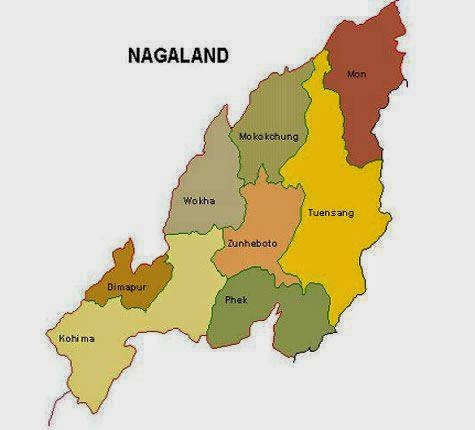
map of nagaland